
1️⃣ Anti-Pattern: “SAFe as a Delivery Wrapper, Not a Data System”
🧩 Business Problem
Organisation launches a multi-year data transformation (cloud, lakehouse, analytics).
SAFe is adopted to “bring structure and predictability.”
Leadership expects faster delivery and visibility.
Data spans multiple domains: ingestion, quality, governance, analytics.
Regulatory pressure requires correctness over speed.
Multiple teams depend on shared data assets.
Value is only realised when data flows end-to-end.
However, planning focuses on team-level outputs.
Business sees velocity but no usable insight.
Confidence in the data programme erodes.
⚠️ Team Composition and Process
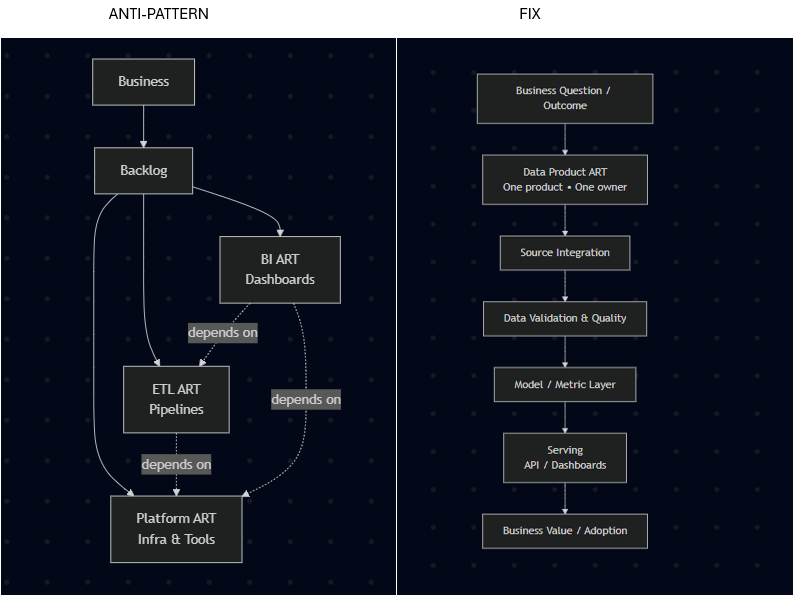
ARTs are formed around technical components (ETL ART, BI ART, Platform ART).
Each team plans independently in PI Planning.
Stories are scoped to “build pipeline,” “create table,” “deploy cluster.”
No explicit data product ownership.
Dependencies are captured but rarely resolved early.
Integration is deferred to late PIs.
Testing focuses on technical success, not business outcomes.
Governance is treated as a separate stream.
Data quality issues surface in UAT or production.
Business outcomes lag by quarters.
❌ Outcome
SAFe ceremonies run perfectly, but value does not flow.
Teams optimise for story points, not usable datasets.
Data assets are “done” but not consumable.
Multiple definitions of the same KPI emerge.
Ownership of end-to-end data is unclear.
Cross-ART issues are escalated too late.
Architecture decisions drift without accountability.
Release trains deliver fragments, not products.
Leadership mistakes activity for progress.
Programme slows despite “agile at scale.”
✅ Fix SAFe Process
Organise ARTs around data products, not components.
Define end-to-end value streams (source → insight).
Make a Data Product Owner accountable per domain.
Plan PIs against business questions, not pipelines.
Enforce integration stories inside the same PI.
Add data quality & lineage as Definition of Done.
Use System Demos to show business metrics, not schemas.
Fund value streams, not individual tools.
Align architecture runway to data contracts.
Measure success by adoption, not velocity.
2️⃣ Anti-Pattern: “Batch Thinking in an Agile World”
🧩 Business Problem
Business expects near-real-time insights.
Operational decisions depend on fresh data.
Legacy batch ETL still dominates thinking.
SAFe is adopted to modernise delivery.
Teams promise agility but design batch-heavy solutions.
Long feedback loops persist.
Incidents are detected days later.
Data corrections are expensive and manual.
Business loses trust in dashboards.
Transformation feels cosmetic.
⚠️ Broken Process
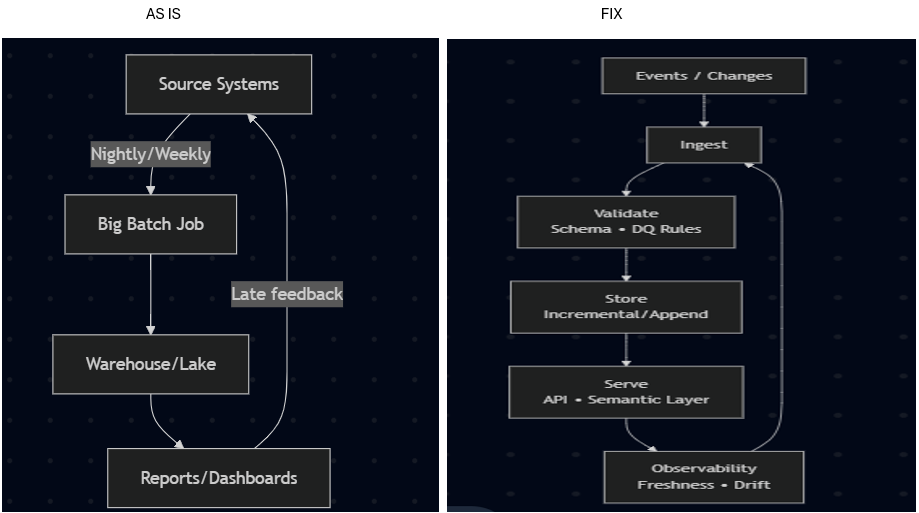
Data ingestion is nightly or weekly.
Changes require full pipeline redeployments.
PI plans assume data availability is static.
Late-arriving data breaks reports.
Reprocessing requires large backfills.
Testing happens after full batch completion.
Errors propagate silently.
Business validation happens too late.
Teams blame upstream systems.
SAFe cadence hides latency issues.
❌ Broken Outcome
“Agile” teams deliver batch pipelines faster.
Micro-batching is renamed as streaming.
Event schemas change without coordination.
Consumers adapt defensively.
Data freshness SLAs are unclear.
Incidents trigger emergency PIs.
Velocity increases but resilience drops.
Technical debt compounds every PI.
Business stops requesting enhancements.
Platform becomes brittle.
✅ Vow Fix !!
Design for event-first or incremental data flows.
Define freshness SLAs per data product.
Make latency a first-class PI objective.
Introduce contract-driven ingestion.
Validate data continuously, not post-batch.
Use small, replayable units of data.
Treat reprocessing as a design requirement.
Demo freshness, not just correctness.
Align cadence with data arrival patterns.
Reward stability over raw speed.
3️⃣ Anti-Pattern: “Governance as a Parallel Stream”
🧩 Business Problem
Organisation operates in regulated industries.
Data privacy, lineage, and auditability are critical.
Governance teams are under pressure.
SAFe is introduced to scale delivery.
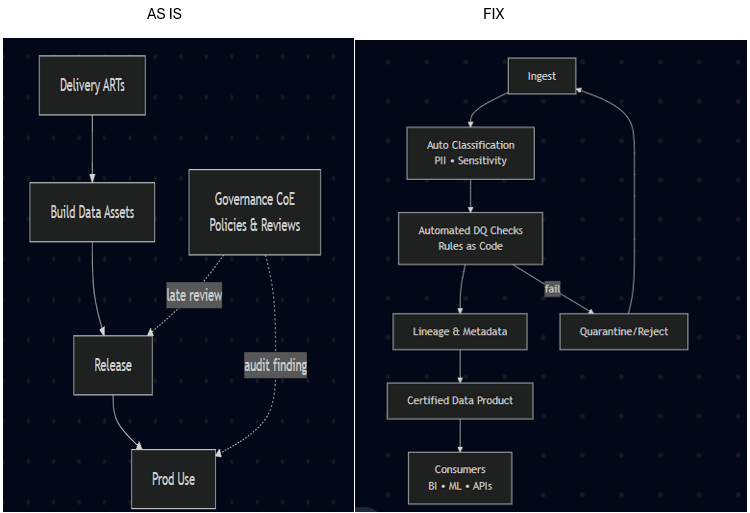
Governance is parked as a separate ART or CoE.
Delivery teams move fast to meet PI goals.
Compliance checks happen late.
Releases are blocked or rolled back.
Friction grows between teams.
Transformation slows under risk scrutiny.
⚠️ Broken Process
Governance defines policies centrally.
Delivery teams interpret them locally.
Metadata is added manually after build.
Lineage is incomplete or outdated.
Privacy reviews happen near release.
Exceptions become the norm.
Audits trigger remediation projects.
Teams view governance as overhead.
Business timelines slip.
Trust between functions erodes.
❌ Broken Outcome
Governance runs in parallel to delivery.
Policies are enforced reactively.
Teams bypass controls to hit PI goals.
Data products lack certification.
Compliance debt accumulates.
Every release needs special approval.
Velocity collapses under controls.
Leadership intervenes frequently.
SAFe is blamed for rigidity.
Innovation stalls.
✅ Vow Fix !!
Embed governance inside the delivery flow.
Make policies executable (rules, checks, constraints).
Add governance criteria to Definition of Done.
Automate lineage and classification at ingestion.
Treat compliance as a feature, not a gate.
Include governance stories in PI planning.
Demo audit readiness in System Demos.
Empower teams with guardrails, not approvals.
Measure risk reduction per PI.
Shift from control to enablement.