
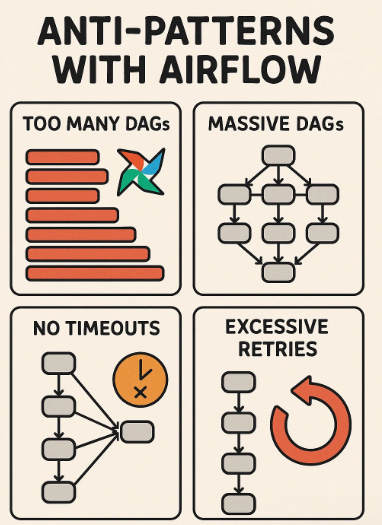
1) Monolithic DAGs
❌ Incorrect (what not to do)
# monolithic_dag.py
with DAG("daily_etl", schedule_interval="@daily", default_args=default_args) as dag:
    load_customers = PythonOperator(task_id="load_customers", python_callable=load_customers_func)
    load_orders = PythonOperator(task_id="load_orders", python_callable=load_orders_func)
    load_payments = PythonOperator(task_id="load_payments", python_callable=load_payments_func)
    # ... imagine 200+ tasks ...
    build_marts = PythonOperator(task_id="build_marts", python_callable=build_marts_func)
    [load_customers, load_orders, load_payments] >> build_marts
✅ Fix (do this instead)
# mart_customers.py
with DAG("mart_customers", schedule_interval="@daily", default_args=default_args) as dag:
    with TaskGroup("staging") as staging:
        load_customers = PythonOperator(task_id="load_customers", python_callable=load_customers_func)
        load_orders = PythonOperator(task_id="load_orders", python_callable=load_orders_func)
    with TaskGroup("warehouse") as warehouse:
        build_dim_customer = PythonOperator(task_id="build_dim_customer", python_callable=build_dim_customer_func)
    staging >> warehouse
Example context: A single
daily_etlbuilds all staging, dims, facts, and marts.Worst-case: Scheduler parse time > schedule interval → missed runs; webserver timeouts; tiny code change triggers parse storms.
Why bad: Airflow’s parser + scheduler scale with DAG size; large graphs slow parsing, scheduling, and UI rendering.
Ops fix checklist: Break into domain DAGs; use TaskGroups, DAG factories; enable DAG serialization; keep per-DAG tasks < O(50–100); add SLA + alerts.
2) Heavy Compute Inside Operators
❌ Incorrect
def train_model():
    import xgboost as xgb
    dtrain = xgb.DMatrix("train.csv")
    params = {"max_depth": 10, "eta": 0.1}
    bst = xgb.train(params, dtrain, num_boost_round=1000)  # hours on worker
    bst.save_model("model.json")

train_task = PythonOperator(task_id="train_model", python_callable=train_model, dag=dag)
✅ Fix
from airflow.providers.databricks.operators.databricks import DatabricksSubmitRunOperator

train_task = DatabricksSubmitRunOperator(
    task_id="train_model",
    json={
        "new_cluster": {"spark_version": "11.3.x-scala2.12", "num_workers": 4},
        "spark_python_task": {"python_file": "dbfs:/ml/train.py", "parameters": ["--date", "{{ ds }}"]}
    },
    dag=dag,
)
Example context: 4-hour XGBoost/ETL runs inside
PythonOperatorblocking worker slots.Worst-case: Worker starvation → other DAGs miss SLAs; OOM → retry storms; cluster instability cascades.
Why bad: Airflow workers aren’t a compute grid; long CPU/RAM jobs defeat concurrency and retries.
Ops fix checklist: Offload to Spark/Databricks/EMR/BigQuery; set execution_timeout, retries with backoff; use queues/pools to isolate; pass params only.
3) Hard-coding Config & Secrets
❌ Incorrect
def upload_to_s3():
    import boto3
    client = boto3.client("s3",
        aws_access_key_id="AKIA123...",
        aws_secret_access_key="abcdEFGH..."
    )
    client.upload_file("/tmp/file.csv", "prod-bucket", "file.csv")

upload_task = PythonOperator(task_id="upload", python_callable=upload_to_s3, dag=dag)
✅ Fix
def upload_to_s3():
    from airflow.providers.amazon.aws.hooks.s3 import S3Hook
    hook = S3Hook(aws_conn_id="aws_default")  # via Secrets Backend
    hook.load_file("/tmp/file.csv", key="file.csv", bucket_name="my-data-bucket")

upload_task = PythonOperator(task_id="upload", python_callable=upload_to_s3, dag=dag)
Example context: Credentials and prod bucket names embedded in DAG code.
Worst-case: Secret leak via Git; audit failure; cross-env deploys break; forced rotations and outages.
Why bad: Violates least privilege, prevents environment parity, and complicates rotations.
Ops fix checklist: Use Connections/Variables + Secrets Backend (Vault/AWS SM/GCP SM); per-env conn IDs; restrict IAM; lint CI to block secrets; rotate regularly.
4) Overusing XCom for Large Data
❌ Incorrect
def produce_data(**kwargs):
    import pandas as pd
    df = pd.read_csv("customers.csv")
    kwargs["ti"].xcom_push(key="data", value=df.to_json())  # 10s–100s MB!

produce_task = PythonOperator(task_id="produce", python_callable=produce_data, provide_context=True, dag=dag)
✅ Fix
def produce_data(**kwargs):
    import pandas as pd, os
    df = pd.read_csv("customers.csv")
    path = f"s3://my-bucket/customers/{{{{ ds }}}}/customers.parquet"
    df.to_parquet(path)
    kwargs["ti"].xcom_push(key="data_path", value=path)

produce_task = PythonOperator(task_id="produce", python_callable=produce_data, provide_context=True, dag=dag)
Example context: Passing entire DataFrames/files through XCom across tasks.
Worst-case: Metadata DB bloat; scheduler and UI slow/crash; backfills time out; DB vacuum/maintenance emergencies.
Why bad: XCom is metadata, not a data lake; large blobs hammer the metastore.
Ops fix checklist: Put payloads in S3/GCS/HDFS; XCom only URIs/IDs; set xcom_backend limits; add DB autovacuum tuning; monitor XCom size.
5) Ignoring Proper Dependencies (sleep/poll hacks)
❌ Incorrect
def wait_for_file():
    import time
    time.sleep(900)  # hope it arrives in 15 min
    return True

wait_task = PythonOperator(task_id="wait_for_file", python_callable=wait_for_file, dag=dag)
✅ Fix
from airflow.providers.amazon.aws.sensors.s3 import S3KeySensor

wait_task = S3KeySensor(
    task_id="wait_for_file",
    bucket_key="incoming/{{ ds }}/file.csv",
    bucket_name="my-data-bucket",
    aws_conn_id="aws_default",
    poke_interval=60,
    timeout=3600,
    mode="reschedule",  # or deferrable variant
    dag=dag,
)
Example context: Upstream data arrives “around” 1am; DAG sleeps then proceeds blindly.
Worst-case: Reads partial files; race conditions corrupt facts; silent data drift; downstream dashboards wrong.
Why bad: Time-based waits don’t encode real dependencies; wastes worker slots.
Ops fix checklist: Use Sensors/Deferrable Operators, ExternalTaskSensor, event triggers; explicit cross-DAG deps; add data quality checks (GE/dbt tests) to fail fast.
Quick global guardrails (apply to all 5)
Airflow = orchestrator, not compute or storage.
Add SLAs, alerts, retry with backoff, idempotent tasks.
Use pools/queues to prevent noisy-neighbor issues.
Keep DAGs modular, parameterized, and environment-agnostic.